
Hunan Provincial Key Laboratory of Sci-Tech Archaeology and Cultural Heritage Conservation and Utilization Officially Launched the First Batch of Open Research Projects
On June 10th, the project launch meeting for “Research and Application of Key Technologies for Preventing and Controlling Biological Damage in Ancient Books Based on Membrane Separation Principle”—one of the first batch of open research projects of Hunan Provincial Key Laboratory of Sci-Tech Archaeology and Cultural Heritage Conservation and Utilization (hereinafter referred to as the “Provincial Key Laboratory”)—was held at Hunan Library. Attendees of the meeting included He Meihua, Director of Hunan Library and Principal of the project, and Ren Zhong, Deputy Director of Hunan Library; Li Lihui, Secretary of the Disciplinary Inspection Commission of Hunan Museum and Director of the Office of the Provincial Key Laboratory, and Wang Yifei, Director of the Scientific Research Management Department and Deputy Director of the Office of the Provincial Key Laboratory; Long Huan, Executive Principal of the project; as well as other members of the research team.
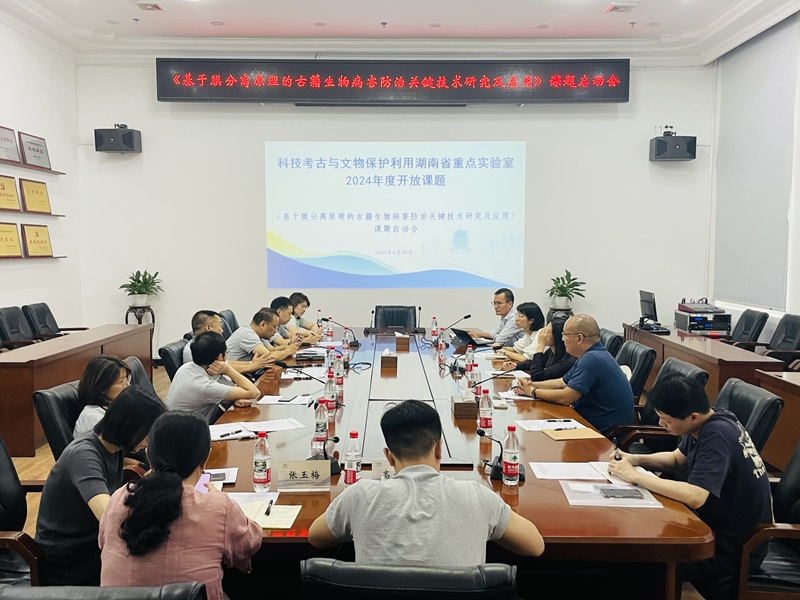
Wang Yifei hosted the meeting and briefly introduced the open research projects of the Provincial Key Laboratory. He stated that the Provincial Key Laboratory has set up open research projects for researchers from cultural and museum institutions, higher education establishments, scientific research organizations and other units at home and abroad. This move aims to break down institutional and disciplinary barriers, gather high-quality scientific research resources at home and abroad, strengthen academic exchanges and collaborative innovation, and enhance the scientific research on cultural relics in Hunan Province. For the first batch of open research projects, after going through procedures such as publicly soliciting research directions, issuing application notices, and organizing project approval review meetings, 5 projects were finally approved for establishment. These projects include “Research on Corrosion Mechanism and Protection of Underwater Ancient Ceramics”, “Scientific and Technological Archaeological Research on Typical Jade Artifacts Unearthed in Hunan”, “Development of 3D Modeling Software for Digital Protection of Cultural Relics”, “Research and Application of Key Technologies for Preventing and Controlling Biological Damage in Ancient Books Based on Membrane Separation Principle”, and “Research on Corrosion Characteristics and Corrosion Mechanism of Bronze Artifacts Unearthed in Hunan”. A total of 300,000 yuan has been allocated to support these projects. Each open research project team is encouraged to make full use of the equipment resources and academic platform of the Provincial Key Laboratory, and adopt a rigorous scientific research attitude and innovative thinking to produce pioneering research outcomes that will promote the high-quality development of the cultural relics conservation cause in Hunan Province.
He Meihua, serving as the principal of the project, delivered a passionate speech at the meeting, expressing both great importance and earnest expectations for the project. He pointed out that ancient books, as precious heritage of human civilization, carry rich historical and cultural information. However, they have long been threatened by biological damage, which seriously affects their preservation and utilization for research purposes. The launch of this project aims to explore a set of efficient and feasible solutions for the prevention and control of biological damage in ancient books by virtue of advanced membrane separation technology. It represents a crucial practice of in-depth integration of science and technology with ancient book preservation, and will pave new pathways for the field.
Subsequently, Long Huan provided a comprehensive overview of the project plan from four perspectives: project background introduction, project progress planning, advantages of innovative technologies, and application demonstrations. She stated that the project aims to apply membrane separation technology to prevent and control biological damage in ancient books. By studying the principle of membrane separation and building a membrane separation-based environmental monitoring and control system, the project aims to effectively kill or inhibit molds and pests on the surface and inside of ancient books. This will significantly improve the preservation environment of ancient books, reduce damage caused by biological threats, and extend their service life. At the same time, the project will realize real-time monitoring and management of the ancient book preservation environment, providing scientific and effective technical support for the conservation of ancient books. The project is expected to form a complete achievement system including prevention and control technical specifications and testing standards, which will provide a scientific basis and practical guidance for the preventive protection of ancient books. In addition, Long Huan gave a detailed introduction to the time nodes of each project phase and the arrangements for various tasks, ensuring that the project research proceeds in an orderly manner.
Finally, Li Lihui delivered the concluding remarks. She emphasized that since its establishment, the Hunan Provincial Key Laboratory of Sci-Tech Archaeology and Cultural Heritage Conservation and Utilization has been committed to promoting technological innovation in the field of cultural heritage preservation. By integrating resources from various parties and conducting interdisciplinary research, the laboratory has achieved a series of remarkable results. The launch of this first batch of open research projects is another important measure in the development of the Provincial Key Laboratory, marking a solid step taken by the laboratory in expanding research fields and strengthening industry-university-research cooperation. She expressed the hope that the project teams will give full play to their respective advantages, enhance collaboration, promote academic cooperation and realize resource sharing to ensure the smooth implementation of the projects. It is also expected that breakthroughs and practical research results will be achieved in areas such as young talent training and ancient book and cultural relic conservation. Furthermore, she looked forward to this research serving as a reference and model for other cultural heritage conservation projects, thereby further promoting the high-quality development of cultural heritage conservation in Hunan Province.